
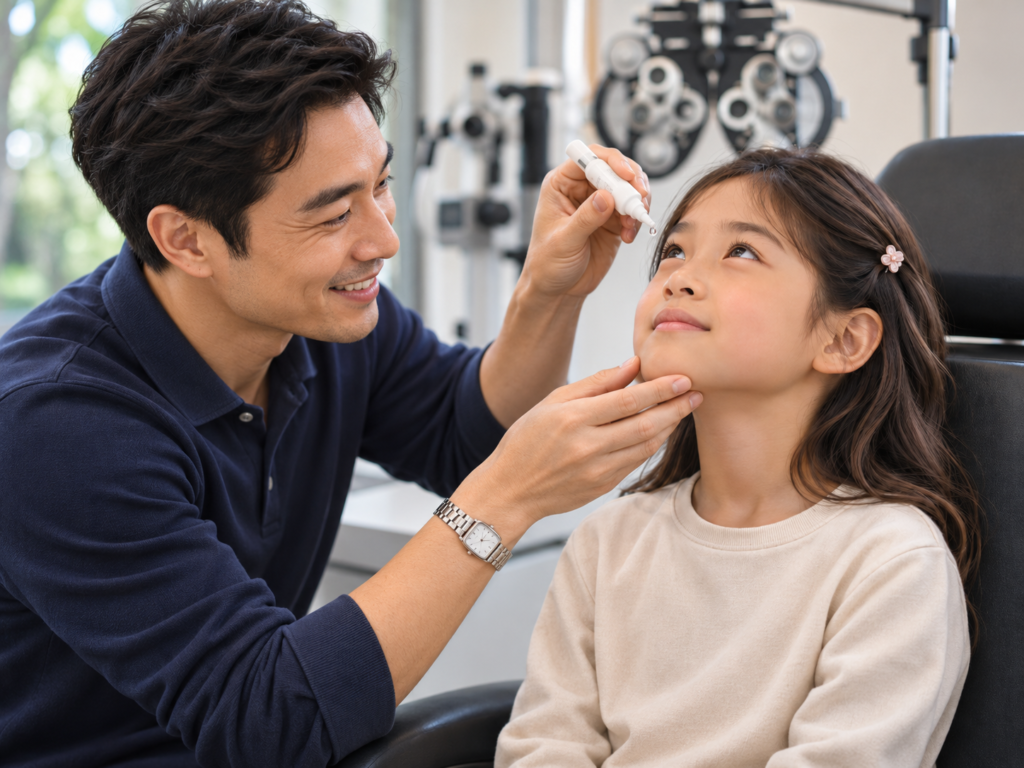
 A girl came in a few weeks ago for what should have been a routine check. She’d always been slightly long-sighted, which is normal for a child, and nobody had any worries about her eyes. Then her standard test came back short-sighted. Minus one in the right eye, minus a half in the left. I watched her parents’ faces change. You could see them already thinking about glasses, and whether this was the start of something.
I didn’t write a prescription that day. We put drops in, waited about forty minutes, and tested her again. This time she read plus one in both eyes. Long-sighted, exactly as she’d always been. Her right eye had swung by two full dioptres, and none of that change was real. It came from her own focusing muscle.
Children have a huge amount of focusing power. The same muscle that lets them read a book held ten centimetres from their nose can tighten up during an eye test without them realising, particularly when they’re tired or concentrating hard on the chart. When it does, the eye behaves as if it’s short-sighted. A standard test without drops, what we call a dry refraction, has no way of telling the difference. Adults don’t run into this nearly as often, because focusing power drops off as we get older. In kids it’s common enough that I never take a new minus result at face value.
That’s why we do a cycloplegic refraction. Cycloplegic drops relax the focusing muscle for a few hours so it can’t interfere, and what we measure afterwards is the eye’s true prescription. If we’d trusted the first result, this girl would have gone home with minus lenses she didn’t need. Glasses like that make a child focus even harder for close work, so they tend to end up with tired eyes and headaches by the end of the school day. She might also have started myopia control treatment for myopia she didn’t have.
The drops answered one question. Our biometer answered the other. It measures axial length, which is the physical length of the eyeball, to within a hundredth of a millimetre, and no amount of focusing can change that number. Real short-sightedness in children almost always comes from the eye growing too long. If her eyes had been stretching faster than they should for her age, the scan would have shown it, whatever the prescription said. Hers were right where we’d expect. That reading now sits on her file as a baseline, so every future scan gets compared against it, and we’ll pick up any change in growth well before she notices the board going blurry.
She’s not off the hook entirely, and I told her parents that. A bit of long-sightedness at her age works as a buffer, because children’s eyes naturally drift toward short-sightedness as they grow. Kids who use up that buffer early are more likely to become myopic later on. So she’ll be back in six months for another scan, and we’ll watch the trend rather than any single number.
If your child needs drops at their next visit, here’s what to expect. They sting for a few seconds and take thirty to forty minutes to work. After that the pupils stay big and close-up reading is blurry for the rest of the day, sometimes into the next morning. Sunglasses help with the glare on the way home. I’d also avoid booking the day before a school test or a big homework night, which is one reason the summer holidays are a good time for a full children’s exam.
If your child’s last test showed a brand new short-sighted prescription, or one that jumped a lot, and no drops were used, it’s worth checking again before you commit to glasses or treatment. At Viewpoint Optical in Hurstville, cycloplegic drops and an axial length scan are both part of our comprehensive myopia control consultation, and we’ll use drops in a regular children’s exam too whenever a result doesn’t add up. Book online or call us on 02 8021 2298 and we’ll get you a proper answer.