
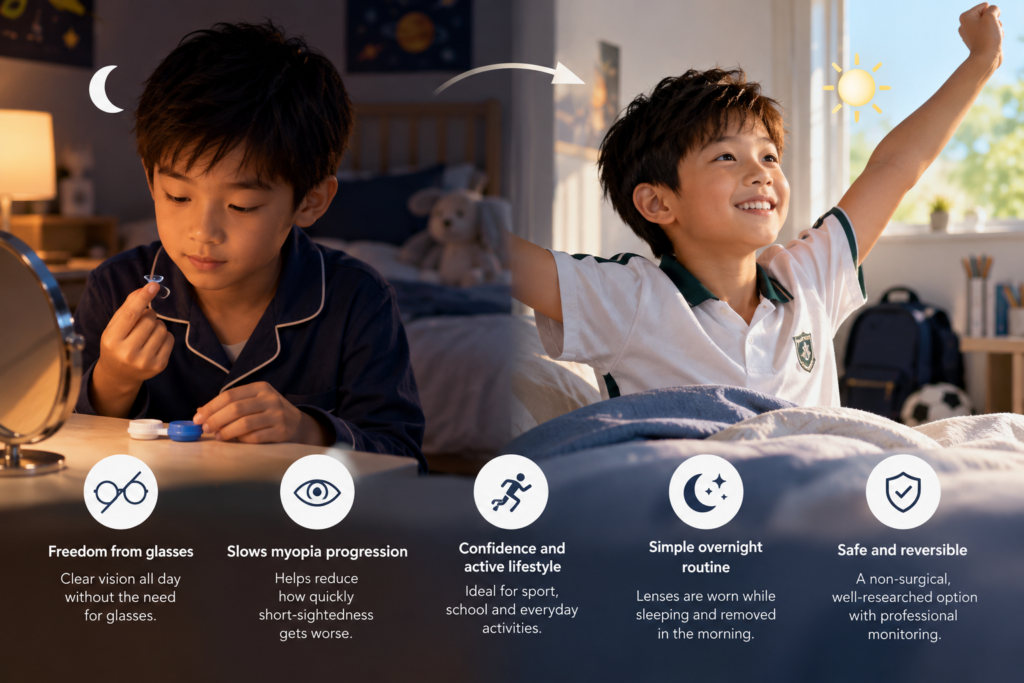
 A mum came in a few weeks ago with her ten-year-old, still in his swim bag from training. He’s in the pool three mornings a week before school, and between the goggles fogging over his glasses and his contacts drying out halfway through a session, mornings had become a real source of stress for both of them. She’d seen something online about lenses you wear overnight instead, and wanted to know if that was actually real or just something in her feed. Fair question. It does sound like a stretch: contacts your child sleeps in, that leave them seeing clearly all day with nothing on their eyes at all.
It’s real, and the way it works is fairly straightforward once you see it explained properly. Orthokeratology, we call it ortho-k for short, uses a rigid, gas-permeable lens custom fitted to the exact shape of your child’s eye. Worn overnight, it gently reshapes the front surface of the cornea while they sleep. In the morning the lens comes out, the cornea holds that new shape through the day, and light focuses correctly onto the retina without any glasses or daytime contacts at all. It’s not surgery and it’s not permanent. Skip a few nights in a row and the cornea gradually drifts back toward its original shape within about a week, which tends to reassure parents more than anything else I tell them.
There’s a bigger reason we recommend it for a lot of the short-sighted kids who come through our door, beyond the daytime convenience. It slows down how quickly their eyes keep growing. In one of the larger studies on this, children fitted with ortho-k showed roughly a third less axial elongation over two years than children wearing standard single-vision glasses. Myopia getting worse each year means more than a stronger prescription on paper. The eyeball itself is physically growing longer, and more of that growth during childhood raises the risk of problems like retinal thinning later on.
I’ll be honest about the range in how kids respond, because it varies more than most parents expect. Some children barely progress at all once they’re on ortho-k. A smaller group still progress more than we’d like, even wearing the lenses every night. I can’t give you a number before we’ve actually measured your own child’s eyes over a few visits, but what I can tell you is that we track it properly, with axial length measurements at each check rather than relying on the vision chart alone.
For a kid who swims before school, the daily practicalities are usually what seals it for parents, more than the growth numbers. There’s nothing to fog up under goggles, and no lens threatening to dry out and slip out mid lap. He puts the lenses in before bed and takes them out when he wakes up, and by the time he’s towelling off after training, his eyes are just doing their job on their own.
Ortho-k isn’t automatically the right fit for every child, though. It suits mild-to-moderate myopia best, and it needs a child, or a parent, comfortable and consistent with inserting and removing a lens and keeping it properly clean, since these are still contact lenses even though they’re only worn overnight. Cost depends on the lens design and how much aftercare is bundled in, and that’s something we walk through properly at a fitting rather than guessing over the phone (we’ve also broken down what affects the cost in more detail separately, if you’d like the fuller picture before you come in). For kids who aren’t quite ready for that level of independence, it’s worth looking at the other myopia control options we offer, including MiyoSmart lenses, which work during the day instead of overnight.
If your child is short-sighted and mornings before school sport have turned into a lens wrestling match, it might be worth asking whether ortho-k suits them. Book a myopia consultation with us in Hurstville or call 02 8021 2298, and we’ll check their eyes properly before recommending anything.