

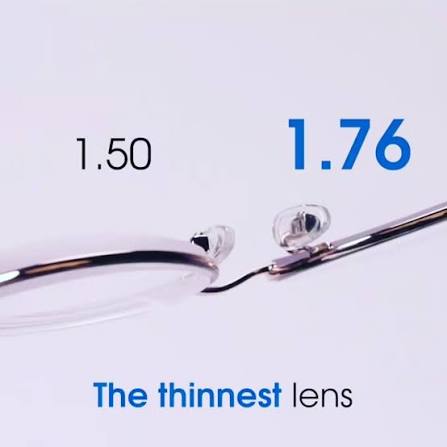
 A man in his forties sat down in my chair a few weeks ago and put his glasses on the desk edge first, like he was showing me evidence. He’s about minus nine in both eyes. He’d paid extra for high index lenses years ago and still felt the edges looked like the bottom of a jar. “Is there anything thinner than this?” There is. It’s called a 1.76 index lens, and for a small group of people it makes a real difference.
What does 1.76 index mean?
The number is the lens material’s refractive index, which is how strongly it bends light. The harder a material bends light, the less of it you need to get the same prescription, so the lens can be made thinner and flatter. Standard plastic is about 1.5. Most high index lenses you’ll be offered are 1.67 or 1.74. Tokai, a Japanese lens maker that’s been going since 1939, makes a 1.76 index lens, the highest index plastic spectacle lens we can get. We’ve been fitting it here in Hurstville for years.

Who should consider 1.76 lenses?
Not everyone, and I talk people out of it fairly often. If your prescription is under about minus four, you’d struggle to see the difference between 1.67 and 1.76 once the lenses are cut into a frame. You’d be paying for a number. It starts to earn its keep around minus eight and stronger, or when there’s a lot of astigmatism on top of short-sightedness. At that point you can see the thinner edge from across the room. The glasses are lighter on your nose too, and your eyes stop looking shrunken behind the lenses.
1.76 vs 1.74: is the difference worth it?
This is usually the real question, because 1.74 is much easier to find. The step from 1.74 to 1.76 is smaller than the step from 1.67 to 1.74, so the gain is modest. For someone at minus six I’d normally suggest a good 1.74 and put the difference toward better coatings. For minus ten and beyond, that last bit of thinness is more noticeable, and that’s when I reach for Tokai.
Are there any downsides?
Two, and neither is a deal breaker. Very high index materials split light a little more than lower index ones, so some people notice faint colour fringes when they look through the edge of the lens. Most adapt within a week or two. These lenses also reflect more light, which makes a good anti-reflective coating more important. Both come down to fitting. We measure exactly where your pupils sit in the frame, so you’re looking through the clearest part of the lens most of the time.
Why the frame matters as much as the lens
Put a thin lens in the wrong frame and it’ll still look thick. For short-sighted prescriptions the lens gets thicker toward the edge, so a big oversized frame puts the thickest part on show. A smaller, rounder shape that sits close to your face keeps the edges slim. We choose the frame and lens together for exactly this reason. Some of the Japanese titanium frames we carry, like our Masunaga range, suit strong prescriptions especially well because they’re light and come in smaller sizes.
How much do 1.76 lenses cost?
They sit at the top of the lens range, so they cost more than 1.67 or 1.74. The final price depends on your prescription, whether you need single vision or progressives, and which coatings you choose. We’ll go through it properly at your fitting rather than guess over the phone. They’re generally claimable under your health fund’s optical extras like any other prescription lens.
If your glasses feel heavier or thicker than they should, bring them in. We’ll show you side by side how 1.74 and 1.76 would look for your prescription, and if the cheaper option does the job, I’ll tell you. Book online or call us on 02 8021 2298.